Lagos Is Becoming a Digital Experience
Lagos Is Becoming a Digital Experience
There is something genuinely exciting about seeing Lagos represented through technology.
Not as a stock image of a busy African city. Not as a generic backdrop for somebody else's story. But as Lagos: the energy, the ambition, the culture, the nightlife, the businesses, the people, the chaos and the everyday experiences that make the city what it is.
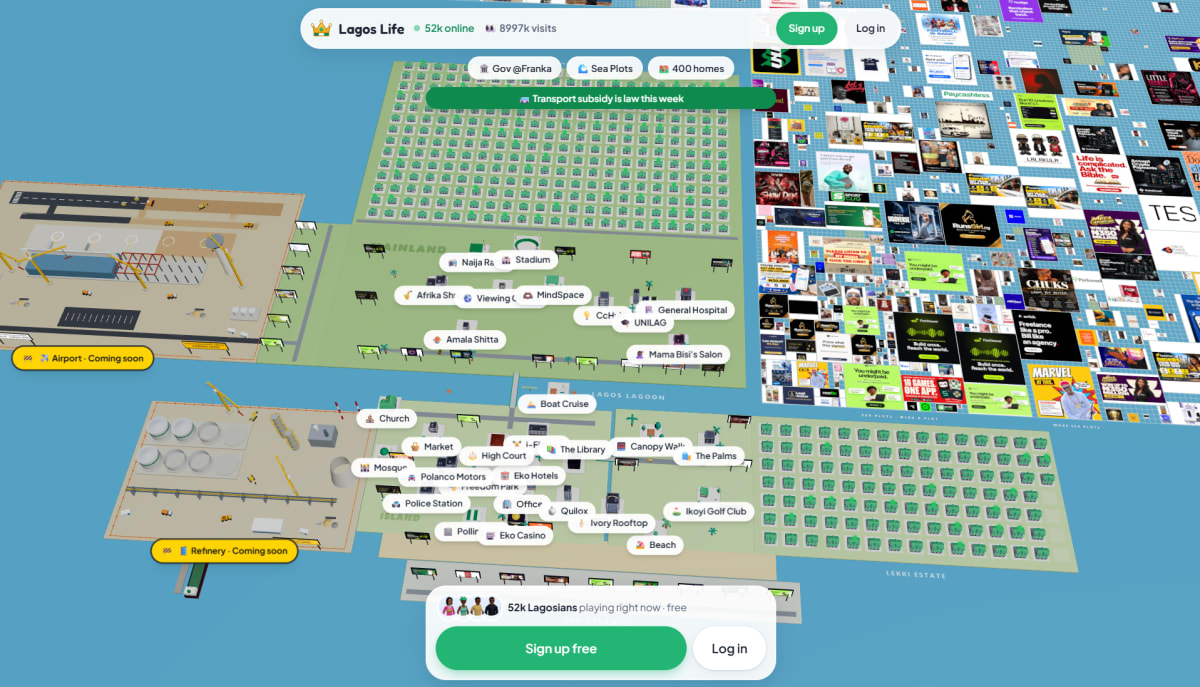
That is what caught my attention about Lagos Life, a browser-based multiplayer life simulation that turns Lagos-inspired environments and experiences into a digital world. At first, it might look like another online game. But the more I think about it, the more interesting it becomes.
Because there is something bigger happening when a city that millions of people experience physically begins to take shape as a digital experience.
When a City Becomes a Digital World
Lagos has always been a city that seems almost impossible to fully describe. There is always something happening somewhere. New businesses are appearing, creatives are building careers, people are moving between neighbourhoods, nightlife is evolving, technology companies are emerging and entire communities are forming around new ideas.
Lagos Life takes some of that identity and translates it into an interactive environment. Instead of simply looking at Lagos through photographs, videos or social media posts, players can enter a virtual representation of the city, create a character, explore, work, interact with other players and build a digital life.
That concept alone is fascinating to me.
We spend so much time talking about how technology is changing the way we communicate, work and consume information. But games and virtual environments give us another possibility: technology can change how we experience places.
A physical city can become a digital space where people can explore, interact and create their own stories.
Technology That Actually Feels Local
One of the things I find particularly interesting about Lagos Life is its localisation.
A lot of digital products are designed to appeal to as many people as possible, which often means stripping away the things that make individual cultures distinctive. The result can be technically impressive but culturally generic.
Lagos Life takes almost the opposite approach.
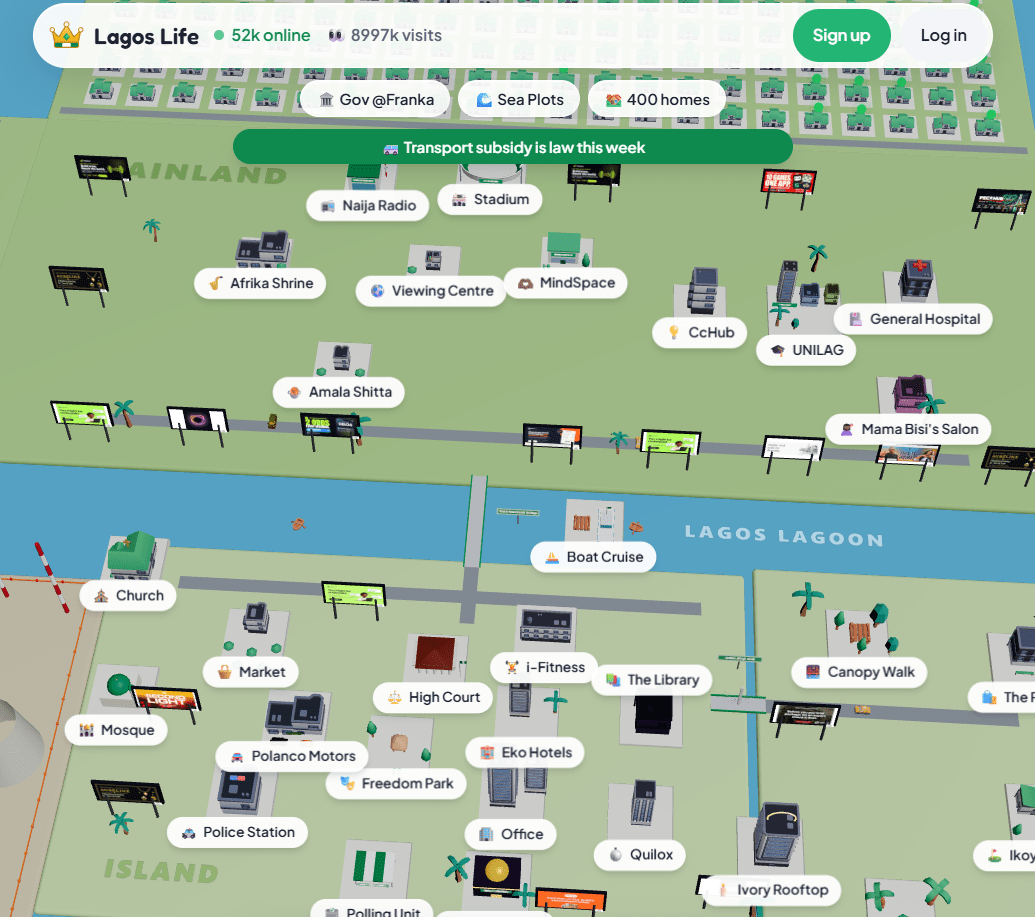
The experience is built around references that Nigerians, particularly people familiar with Lagos, can recognise. Locations and cultural touchpoints inspired by places such as Eko Hotel, the Lekki-Ikoyi Link Bridge, UNILAG, Quilox, CcHub, Afrika Shrine and other parts of Lagos help make the environment feel connected to an actual place rather than an imaginary city with an African aesthetic.
That distinction matters.
Technology becomes much more interesting when it starts reflecting the people who use it. When the names, environments, humour, references and experiences feel familiar, the technology stops feeling like something imported and starts feeling like something that belongs to us.
And I think there is enormous potential in that.
Lagos Has Always Been an Innovation Laboratory
If there is one thing Lagos has never lacked, it is resourcefulness.
People constantly find ways to solve problems, create businesses and adapt to circumstances. From fintech and digital payments to e-commerce, logistics, entertainment and social platforms, technology has increasingly become part of how Lagos operates.
What interests me about projects like Lagos Life is that they represent another side of that technological evolution.
We are not only using technology to solve practical problems anymore. We are also using it to represent ourselves.
That is an important transition.
There is a difference between building technology for Nigerians and building technology that is actually about Nigerian experiences.
The second creates opportunities for storytelling, cultural preservation, entertainment, education and even new forms of social interaction.
From Physical Lagos to Digital Lagos
Think about what happens when familiar places become digital environments.
A location that you normally associate with traffic, nightlife, business or entertainment suddenly becomes something you can explore virtually. A person who has lived in Lagos their entire life can see familiar parts of the city presented in a completely different context, while someone outside Nigeria can get a glimpse into a digital interpretation of the city without physically being there.
That possibility becomes even more interesting when you think about Nigerians in the diaspora.
Imagine someone who grew up in Lagos but now lives thousands of kilometres away being able to enter a virtual environment inspired by the city they remember. Or someone who has never visited Lagos being introduced to its culture through an interactive experience rather than a travel brochure.
It may not replace experiencing the real city, obviously. Nothing can replicate actually being in Lagos.
But technology does not always have to replace reality.
Sometimes it simply gives us another way to connect with it.
And This Is Where It Gets Really Interesting
As a developer, this is the part that makes me start thinking beyond the game itself.
What happens if this idea continues to evolve?
Could digital representations of Nigerian cities eventually become platforms for tourism, education, entertainment, events or commerce? Could businesses have virtual locations? Could creators host experiences? Could people discover real places through virtual ones? Could Nigerian cities eventually have increasingly detailed digital twins that are useful for more than entertainment?
There are a lot of possibilities.
Lagos could be represented not just as a map, but as a living digital environment.
And if Lagos can become a digital experience, there is no reason the concept has to stop there. Abuja, Ibadan, Port Harcourt, Kano, Enugu and other cities all have their own identities, cultures and stories that could potentially be represented through technology.
The important thing is that somebody has to start experimenting with the idea.
Our Culture Deserves Better Digital Representation
For me, this is probably the biggest takeaway.
Africa has no shortage of stories, but for a long time, many of those stories have been represented through platforms, products and perspectives created elsewhere.
There is nothing inherently wrong with that. Technology is global, and good ideas should travel.
But there is something powerful about seeing people from our own environment build things that reflect how we actually live.
Lagos is not just skyscrapers and beaches. It is the street food, the music, the slang, the traffic, the businesses, the universities, the nightlife, the markets, the churches, the beaches, the creative communities, the tech ecosystem, the hustle and the unbelievable energy that somehow keeps everything moving.
Those things are part of our identity.
Technology gives us another medium through which we can preserve, reinterpret and share them.
The Future Might Be More Local Than We Think
There is a tendency to think that the future of technology has to look futuristic.
Artificial intelligence. Robots. Autonomous vehicles. Virtual reality. Smart cities.
All of those things are exciting, but I think there is another version of the future that is just as interesting: technology that becomes increasingly connected to our everyday identities and environments.
Maybe the future is not only about creating completely new worlds.
Maybe it is also about digitising the worlds we already know.
Lagos Life is a small but interesting example of what that could look like.
A city becomes a game. A familiar location becomes a digital environment. Culture becomes part of the user experience. And a browser becomes a doorway into a version of Lagos that exists somewhere between reality and imagination.
Lagos Is Already Moving
Lagos has always been a city that moves quickly.
Technology is simply giving that movement new places to go.
Seeing a Nigerian developer take the idea of Lagos and turn it into an interactive digital experience is exciting because it suggests that we are moving beyond simply consuming technology and increasingly creating experiences that are rooted in our own environment.
And I think we should pay attention to that.
Because the really exciting question is no longer just "What can technology do?"
It is:
"What can we create when we use technology to tell our own stories?"
Lagos already has the stories.
It already has the people.
It already has the energy.
Now, increasingly, we are finding new ways to put all of that online.